Featured Articles

Postural Assessment for Beginners

By Jane Johnson

If you have spent any time at all in the massage world you will probably have heard of postural assessment. Like many of us, you have probably got more than your fare share of clients suffering from upper back and neck pain, perhaps resulting from the fact that they spend long hours slumped at a desk in front of a computer monitor with terrible posture. And like all good massage therapists you were probably taught to take a detailed case history before beginning treatment with each new client, asking about old injuries and ailments, as well as about current medical conditions, medication and possible contraindications. Once you have completed your case history, then what do you do? You probably help your client straight to the couch ready to receive treatment, and that is that.

From Family Home to Clinical Settings - Indian Head Massage

When Narendra Mehta first introduced Indian Champissage to the UK in 1981, little did he know the impact that this deeply relaxing therapy would have – not only in the UK but internationally too. The versatility of the therapy, now better known as Indian Head Massage, has meant that it can be safely and effectively adapted to suit all ages, conditions and situations. Indeed, Indian Head Massage is now popular not only in family homes, spas and beauty and hairdressing salons, but also in airports, offices and schools, and clinical settings such as hospitals, hospices and care homes.

LaStone Therapy

- the thermotherapy treatment … that uses more than just hot stones.

As the innovators of stone massage in both Europe and the USA over the past 14 years, LaStone have maintained and grown a flourishing education programme that aims to educate for excellence.

More than a ‘hot stone’ body massage it is a Total Therapy System designed to create master practitioners and enable therapists to develop their skills in a range of treatment fields. With over 25’000 therapists working in over 100 countries worldwide, the popularity of LaStone has grown consistently through the years and treatments are now available in major destination spas, hotel groups, health hydros and private centers. All qualified LaStone therapists automatically become members of an International network that supports all types of therapists across the health industry. These ambassadors deliver the highest quality treatments and the LaStone philosophy to their clients.

Manual Lymphatic Drainage – Vodder Method

By Dee Jones

Manual Lymph Drainage (MLD) is a fast growing area of massage – and one that uses the lightest of touch. It takes time to master this light touch and so the training is in three parts, each module usually separated by a month or more in order for the student to practise. Courses are only open to those who have already qualified and practised in another bodywork field.

Beware of imitations however. There are many people and schools who profess to teach the Vodder method of MLD without having gone through the rigorous training a properly qualified Vodder teacher has gone through. (It takes two years of teacher training for each of the first two modules and three to four additional years to qualify to teach the third module.) If you are contemplating adding this valuable skill to your repertoire ask who the tutor has trained with and ask to see their teachers certificate.

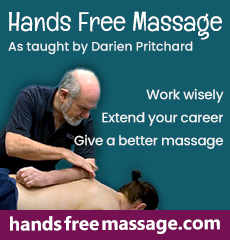
Taking Care of Your Fingers in Massage - Dynamic Bodyuse for Massage Practitioners

by Darien Pritchard

This is the third in a series of articles extracted from a forthcoming book on Dynamic Bodyuse for Effective Strain-free Massage which is designed to promote good bodyuse as an integral part of doing massage. It presents guidelines on how to reduce the poor working habits that take a cumulative toll on the massage practitioner’s body. The previous article focused on protecting your thumbs. This and the next articles will focus on how to look after the other common ‘tools’ used to deliver massages - your knuckles, fist, forearm and elbow. Future articles will then cover using the rest of your body to back up those working ‘tools’.

Seeing Hands - a new profession for the blind in Nepal

by Rob & Sue Ainley

Blind people have always preferred ‘hands on’ professions, and in Asia, the tradition of the blind masseur is centuries old. Early texts indicate that blind people in China, Japan and Korea have been formally trained in therapeutic massage and acupuncture since Medieval times and over 50,000 blind or visually impaired masseurs now earn a living in the Asia-Pacific region.

In South Korea, a law passed in 1987 actually states that the profession of massage is reserved for the blind, (preventing sighted people from learning the trade), but a recent ruling by the courts threatens to end this exclusive right. 6,500 registered blind and visually impaired masseurs currently work in South Korea but prejudice still restricts jobs for the blind in other professions. In protest against the new rulings, one blind masseur has already thrown himself from a high rise building and two others have jumped onto the tracks of a Seoul subway station.

Sports Massage - Getting the Frozen Shoulder

- adhesive capulitis by Susan Findlay

Continuing our series examining the common conditions that a sports & remedial massage therapist will come across on a regular basis, Susan Findlay of the North London School of Sports Massage looks at Frozen Shoulder, the cause, effect and treatment.
Frozen shoulder, also known as "adhesive capsulitis", is a restrictive condition that can be painful and frequently affects abduction and external rotation of the shoulder joint.

It affects more women than men, and usually occurs between the ages of 40 and 65. In the past, it was thought to be a degenerative condition, but since it is rarely found in those over 70 years of age, this theory has been dismissed.

The Business of Massage

by Sam Ward

After qualifying in ITEC Holistic Massage (Clare Maxwell Hudson School) in 2004 I registered as a sole trader with my business Amica Health in April 2005. One year into the business I thought it might be useful to review and share some of the experiences I have had of working as a Massage Therapist to date. It would be great to write about some of the fantastic discoveries I have made such as the therapeutic benefits of massage for the Practitioner (I always feel at peace and content during and after working) or the fascinating variety of the work, the amazing people you get to work with or the sense of fulfilment experienced through massage. However, this piece is going to focus on the business side of massaging.

Marathon Runner's Casebook

The therapist’s role in helping the first time marathon runner survive

By Richard Snieg

Setting the Scene

I first met Ros, a busy TV executive, in late 2000; she was looking for 'de-stressing' after a particularly gruelling schedule. The initial treatment followed my mandatory case history and highlighted no primary health risks and gave no cause for concern apart from the impact the usual ‘21st century stressed lifestyle’ has on the body. Neck and shoulder stiffness were, therefore, dealt with quickly and effectively using predominately therapeutic techniques with some mild myofascial releases to the SIT muscles (supraspinatus, infraspinatus and teres minor), rhomboids and levator scapulae. This 21st Century Lifestyle also seems to present a recurring pattern of ‘rigidity’ of the trapezius, sternocleidomastoids and scalenes.

Supporting Pregnancy with Massage Therapy

by Carole Osborne-Sheets

Nurturing touch during pregnancy, labour, and the postpartum period is not a new concept. Cultural and anthropological studies reveal that massage and movement during the childbearing experience was and continues to be a prominent part of many cultures’ healthcare.1 Studies indicate that most of the more peaceful cultures use touch prominently during pregnancy and early childhood.2 Midwives, who for centuries have provided maternity care, have highly developed hands-on skills.

Current research on the benefits of touch is providing a contemporary basis for its reintroduction in many technological societies, including the United Kingdom. Scientists have found that rats restricted from cutaneous self-stimulation had poorly developed placentas and 50% less mammary gland development. Their litters were often ill, stillborn, or died shortly after birth due to poor mothering skills.3 Pregnant women massaged twice weekly for 5 weeks experienced less anxiety, leg and back pain. They reported better sleep and improved moods, and their labours had fewer complications, including less premature births.4 Studies show that when women received nurturing touch during later pregnancy, they touch their babies more frequently and lovingly.5 During labour the presence of a doula, a woman providing physical and emotional support, including extensive touching and massage, reduces the length of labour and number of complications, interventions, medications, and Caesareans.6

Syndicate content